
has hell frozen over?

Has Hell frozen over here at Volatus? Is that a cork in one of our bottles? Haven’t seen one of those since the 2014 vintage, what is going on?
As most of you know, I am a full convert to the Lux screwcap. We have used them exclusively since the 2015 vintage after a disastrous experience with corks. Quick version, 2 of every 3 corks were bad in a lot of 125 cases. Lost the entire vintage of our 2014 white Rhône-style blend. Honestly, the few bottles with good corks are still tasting insanely good; I tried one over Chrismtas and it was so good.
Our screw cap closures are simple, elegant, and very effective. They allow the wine to age gracefully and breathe with a standard oxygen transmission rate of about 3 picoliters per day. I’ll expound more on that topic as it is always a good point of discussion since the common wisdom is still that screw caps are relegated to cheaper, lesser wines.
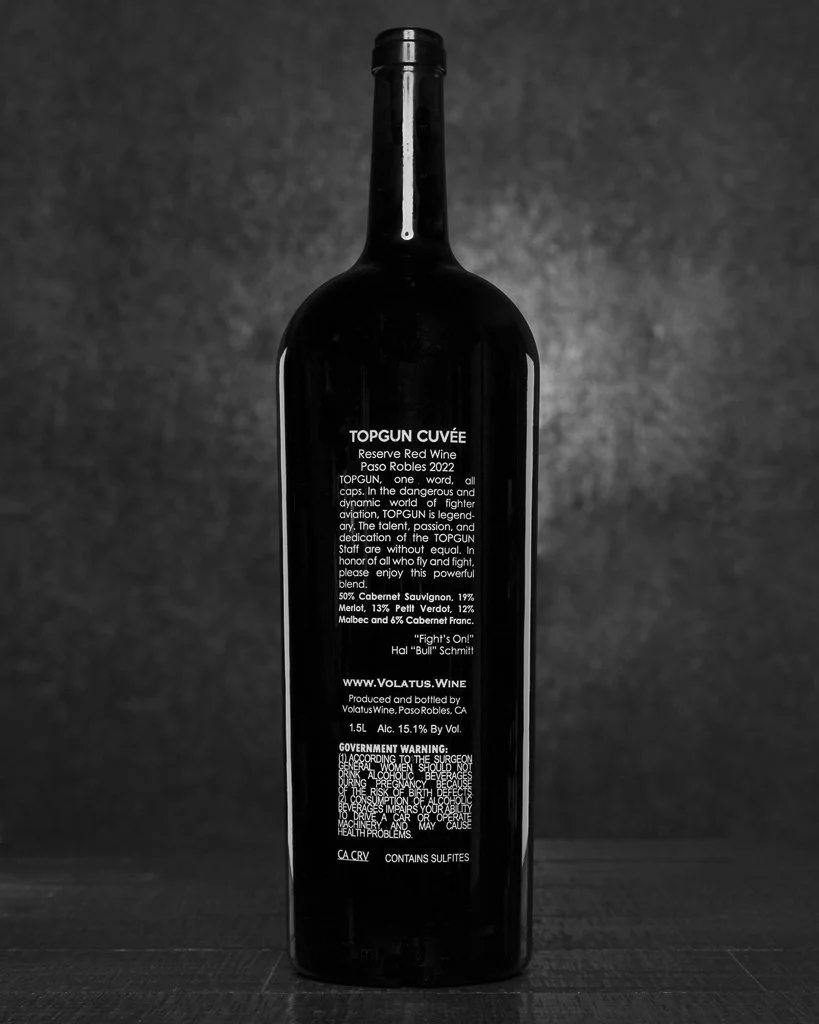
Back to corks. The savvy follower of Volatus social media probably already noticed some images of bottles with corks recently published and celebrated. So what is going on? We engraved a series of 1.5 liter bottles, commonly called a Magnum, and filled them with three amazing wines: the 2022 TOPGUN Cuvée(Cabernet Sauvignon based blend), the 2023 Bloody Well Right(100% Tannat), and the 2021 F-Pole (100% Cabernet Franc). I chose to use bottles with a cork closure as I recently found and validated a newer cork brand that is free of almost every cork issue.
We are using the Diam cork closure, it is a composite cork held together with beeswax. The cork is free of over 200 different potential flavor, aroma, and tannin contaminants. Interestingly, I did not even know there were that many issues with natural corks. Sure there is 2,4,6,-Trichloroanisole (TCA) which leads to the problem of cork taint and the less common Cork Tannin Astringency (CTA) issue. But the chemical compounds in cork that are able to negatively impact your wine are myriad.
The Diam cork process takes natural cork and cuts it into very small pieces. These are then treated with a supercritical CO2 solution that strips any and all chemicals from the cork. When analyzed, the company has identified over 200 compounds that may contribute to different flavors and aromas in the wine. If you ever have the opportunity, Diam has small vials of the chemical mix. Suffice to say, the smell is atrocious. That is not to say every wine closed with a cork has these potential off flavors and aromas, but there is always the possibility.
I often talk about attention to detail in the winemaking process. It is very important to me to understand and know the flavors, aromas, tannin, and acid of every wine I put in bottle. Moreover, I much prefer the wine in bottle will be the exact same as the final blend just before bottling. With our Lux screw caps and now with Diam I am confident the wine will deliver exactly what I intended. With natural cork, it is, to me, a crap shoot and I cannot do that to the wine and our dedicated followers.
For our magnum project, we used the beeswax Diam composite corks free of contaminants and the micro plastic binders found in many composite corks. So yes, those are corks in a Volatus wine and Hell has officially frozen over.
Fight’s On!
Bull Schmitt
